






The Most Unique Stays in Greece
Some of the best rooms in Greece were never meant to be rooms at all. They were sponge factories, wine tanks, miners’ cottages, mountain sanatoriums, Ottoman mansions, watchtowers built to keep people out.
Some of them sit on islands most people cannot place on a map. Others hide behind unmarked doors in the middle of cities you thought you knew.
What they share is a sense of having been loved into their current form, usually by one or two people with an idea and a great deal of patience.
Here are the ones we love to keep coming back to when we want something unique.
Our favorite unique stays in Greece
Manna, Arcadia
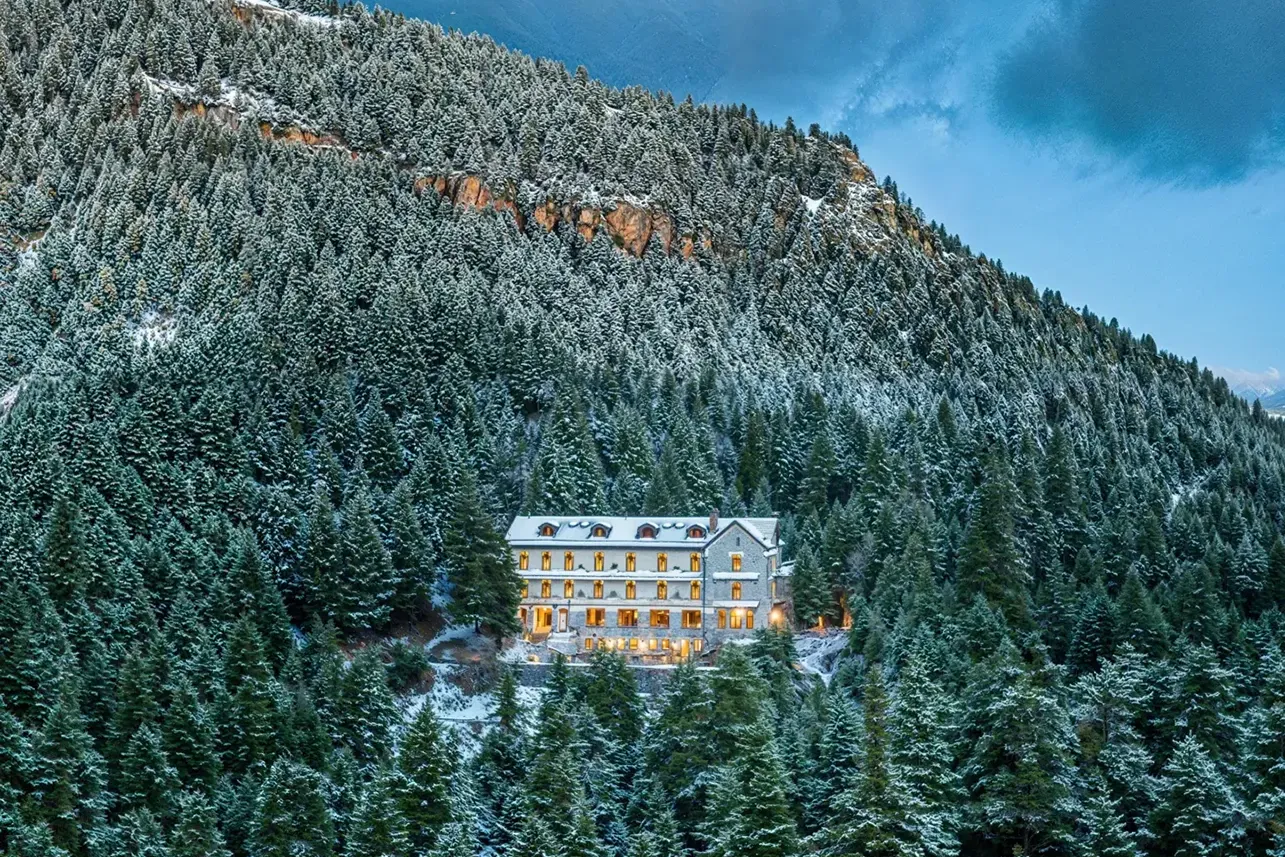
Twelve hundred metres up Mount Mainalo, in a silver fir forest, Manna is the rare Greek hotel with nothing to do with the sea. This is Arcadia, the name that has meant unspoiled country since antiquity, and the building began here as a mountain sanatorium in 1929 before standing empty for most of a century. K-Studio brought it back with the lightest possible touch. The rooms are made for cold air and long evenings: chestnut panelling, terrazzo and marble underfoot, raw linen and wool, copper tubs in the suites, and a fire never far from wherever you settle. The furniture was made by hand nearby, and the windows put the forest in the room with you.
Days are for the outdoors and evenings for the fire. Walk the Menalon Trail from the door, ride, ski or spend a morning hunting mushrooms in the forest, then come back for a hot soak and a glass of something local. Summer brings the trails and the rivers, but Manna also make a strong case in winter, when the snow comes in and the fires take over.
Dexamenes Seaside Hotel, Peloponnese
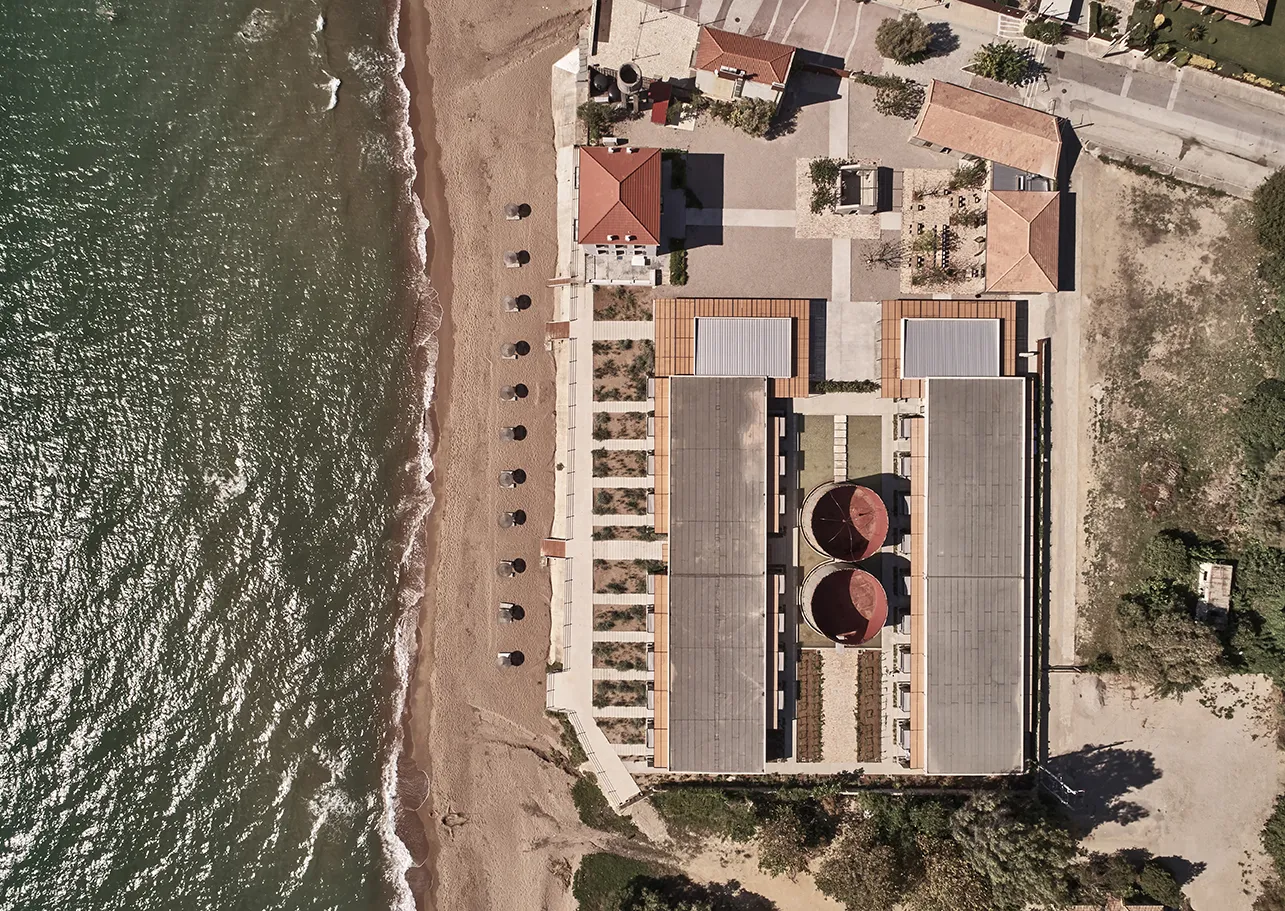
A 1920s wine factory on Kourouta beach, converted tank by tank into suites. When the currants trade collapsed in 1910, Greece turned its unsold stock into wine, and Dexamenes was built directly on the water so ships could load from pipes laid across the sand. Athens practice K-Studio opened the tanks on one side, left the concrete raw, and fitted them with oak, glass and CocoMat beds. Thirty-four Wine Tank Suites, two Seaview ChemLab Suites in the former laboratory building, and eight new Seaview Terrace Suites added above the tanks in 2026, each with an infinity water channel at the edge of the terrace that reads as the horizon. Few hotels in Greece do more with less.

Bratsera, Hydra
A sponge factory from 1860, turned into a 25-room hotel in 1994 and still the only place on Hydra with a swimming pool. The pool is where the sponges were once washed, sized and sorted, and you can see the old sorting room next door, now the lounge. The family that owns it has been on the island for generations; the name refers to the mother-ship that carried sponge divers out through the Mediterranean every May and brought them back in October. Rooms are all different, shaped by the bones of the original building. The restoration won a Europa Nostra diploma in 1996. Four minutes from the port, no steps, and a vine-shaded courtyard where you will find yourself ordering another round.

Coco-Mat Eco Residences, Serifos
Thirteen miners’ houses, begun in 1910 by the French iron-mining company that once ran Vagia bay, left as ruins for most of a century, and finally united into a hotel by architect George Zafiriou in 2000. Serifos was called the Iron Lady in her industrial years, and the old detail has been kept with care. Sieves from the mine work became ceiling lamps, wooden beehives became bedside tables, sea pebbles cover the roofs to keep the rooms cool. The property is on the beach, reached by a set of stairs carved into the hillside. Serifos remains one of the least-developed Cyclades, and Coco-Mat is the strongest argument for going.
Milia Mountain Retreat, Crete
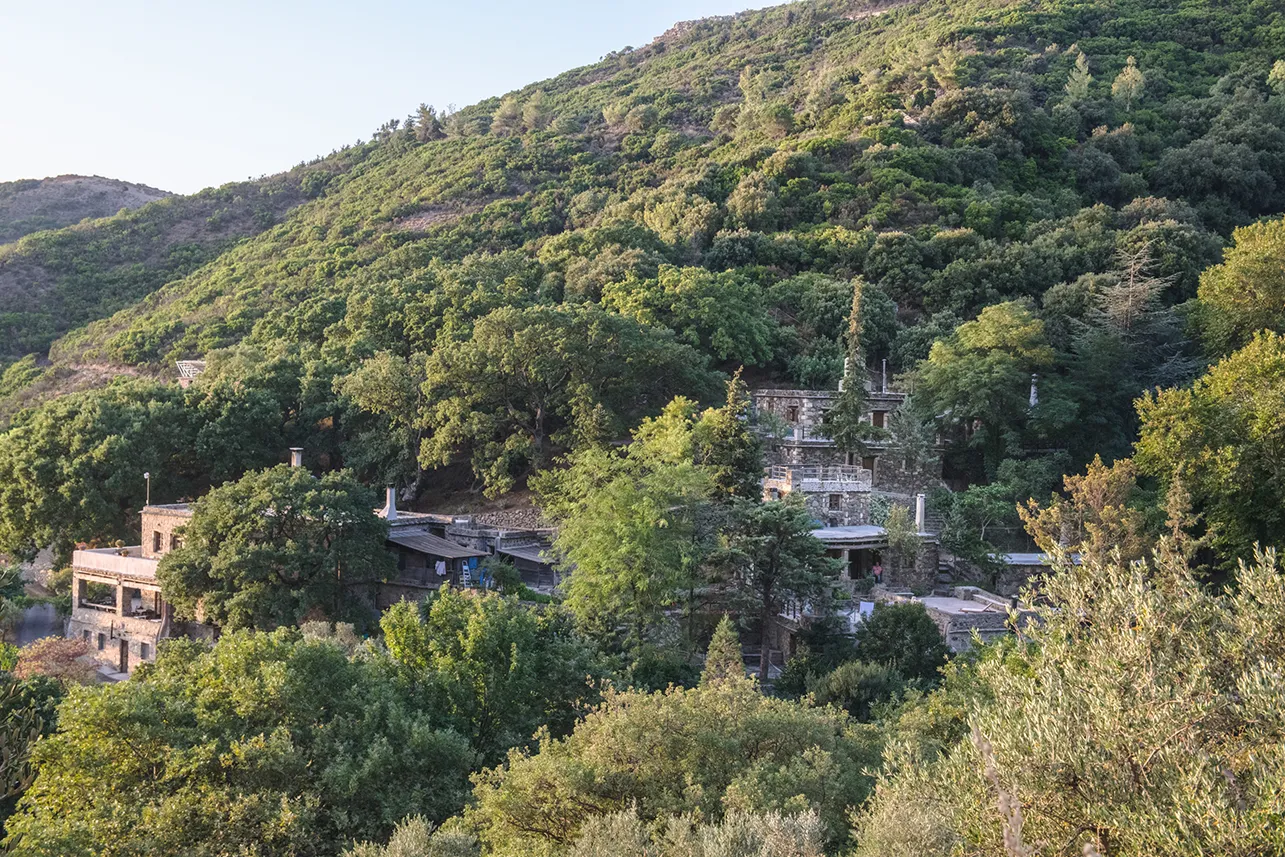
Fourteen restored shepherds’ cottages in a fifteenth-century village deep in Crete’s White Mountains, with no connection to the electrical grid. Milia was abandoned for decades after the Second World War, when it had served as a hideout for Cretan resistance fighters. In 1982 two local friends, Tassos Gourgouras and Giorgos Makrakis, began rebuilding it, stone by stone, using solar power and the surrounding chestnut forest. The restaurant uses wood fire and gas for all dishes, and it’s one of the most unique and delicious spots on the island (no small feat for Crete). Days are spent observing nature, reading books, and walking the nearby trails; the closest beach is about a 40 minute drive for those who may want to leave the village. The last three kilometres leading up to Milia are on a dirt road, and then you are somewhere else entirely.
The Old Markets, Symi
A Greek National Monument on Symi’s horseshoe harbour, bombed into ruin in 1944 and rebuilt over five painstaking years. Ten rooms divided between the Ancient Agora, where each is set inside a former trade-route shopfront, and the Captain’s Mansion next door, which was added in 2016 around a secret courtyard garden. The Arabian Room reads in navy silk and carved bedheads; the Symi Suite has hand-stencilled ceilings and five windows that fling open onto the port. The restaurant, Agora, serves Michelin-trained Mediterranean cooking on the rooftop with incredible views of Symi harbour. Rooms vary considerably in feel, and we know which ones to put you in.
Marco Polo Mansion, Rhodes
A five-hundred-year-old Ottoman mansion in the Turkish quarter of Rhodes Old Town, with one room set inside a former harem and another a former hammam. Italian artist Giuseppe Sala, the Greek-born Effie Dede and her husband Spiros found the derelict house more than two decades ago, and restored it slowly, in a spice-and-pomegranate palette unlike anything else in the Old Town. Antique four-poster beds, hand-painted ceilings, Oriental rugs, and orange and tangerine trees filling the courtyard. The garden restaurant is one of the finest tables on the island. If you are spending a night in Rhodes on the way to smaller islands of the Dodecanese, this is where you stay.
Melanopetra, Nisyros
Two apartments on the rim of an active volcano, in Emporios, a village that is slowly coming back from ruin. The 1850 house is built from the black stone that gives Melanopetra its name, and the architect Anna Apostolou bought the ruin and restored it herself, keeping the old bread oven as part of the kitchen and the original rainwater cistern beneath the downstairs bathroom, where you can still hear the water running. It won a Europa Nostra award in 2016, though that is the least interesting thing about it. Nisyros is one of the least-visited Dodecanese islands, and the volcano below the house is part of the point. Book both apartments if you can.
Tainaron Blue Retreat, Mani
A three-suite hotel inside a nineteenth-century fortified tower at the southernmost tip of mainland Greece, 150 metres above the sea. Architects Kostas Zouvelos and Kassiani Theodorakakou bought the ruined watchtower and restored it over five years, using original local stone, wood and marble, and adapting its vertical plan into suites stacked on top of one another. The cape is where the ancient Greeks believed the entrance to the Underworld lay; the cave is still there, a short walk away. Meals are served on the veranda or beside the infinity pool, with Kostas usually in attendance. A place older than almost anywhere else you could book a room.

1900 Hotel, Symi
A four-suite hotel in the listed 1862 mansion that belonged to Captain Mastoridis, who brought the first autonomous diving suit from the British to Greece. His wife was the first person to wear it, stepping into the harbour in front of a crowd of men who had refused to try. That single act changed the economy of the Dodecanese. Architect Dimitris Zografos bought the empty house on a whim, restored it with his partner Vicky, and kept almost everything: hand-painted ceilings, vaulted tile bathrooms, carved wooden closets, fireplaces set into the walls of former kitchens. The terrace above the port is the best seat on the island for watching a summer morning unfold.

Aristide, Syros
A neoclassical mansion in the Vaporia quarter of Ermoupoli, the grand maritime capital that the rest of the Cyclades tends to forget. The house belonged to a shipowner, then for a time served as the tax office of the Cyclades, before the writer Oana Aristide took it on with her sister and mother and made it nine suites, an art gallery and a studio for an artist in residence. The restoration kept faith with the real thing: doors with proper keys, ceilings left as they were found, lobby marble cut from the same Pentelic seam as the Parthenon. The rooftop looks out over the pastel houses of Vaporia to the open sea. Ermoupoli still earns its keep as a town, and rewards far more than the single night most people give it on the way to somewhere else.
Villa Clara, Leros
The Patrick & Joan Leigh Fermor House, Kardamyli
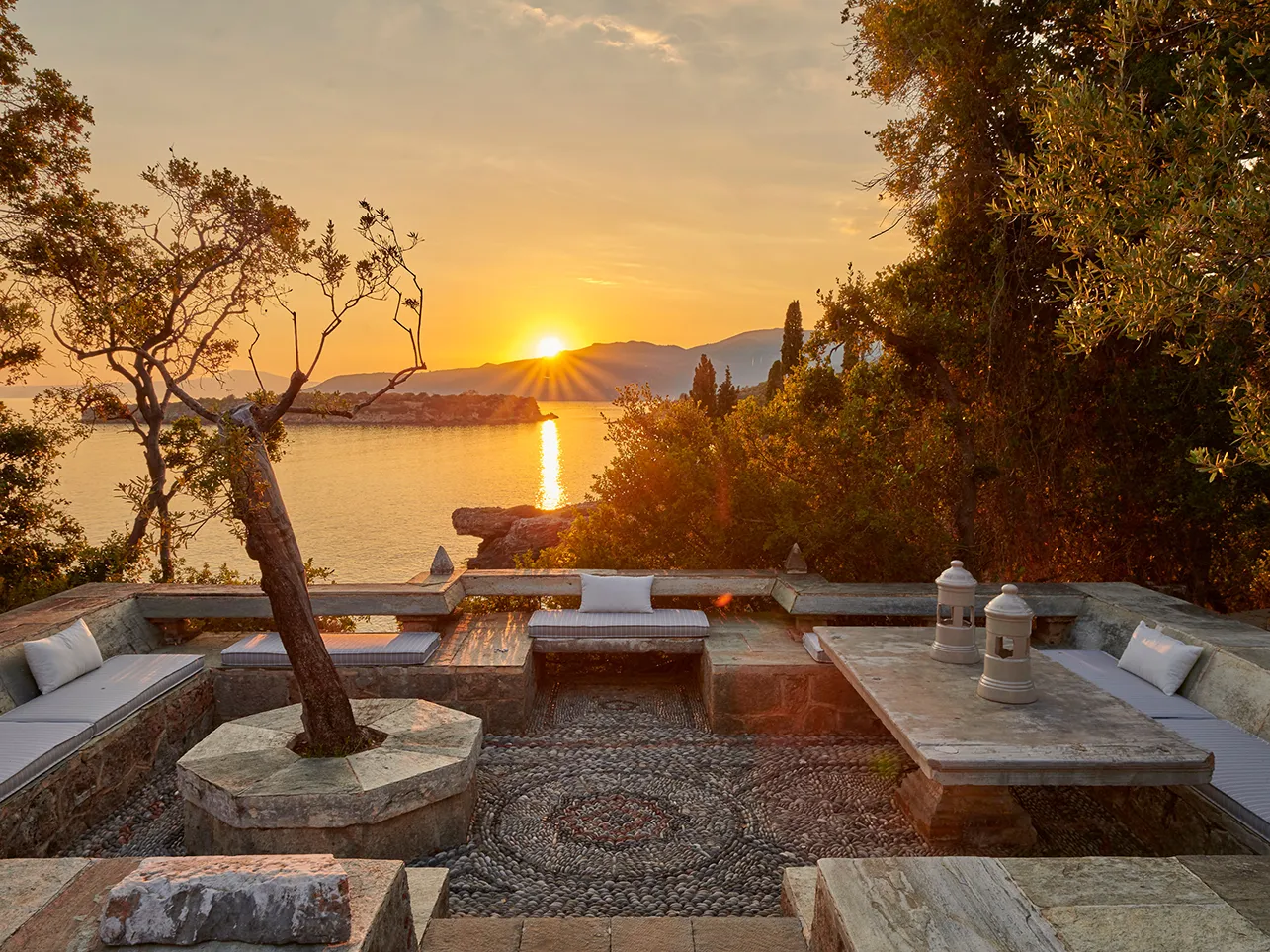
The writer’s own house, on the Mani coast, open for stays for four months a year. Patrick Leigh Fermor, the finest English travel writer of the twentieth century, built it with his wife Joan in the 1960s and wrote most of his later books here. On his death he left it to the Benaki Museum, which now opens it for guest stays from June to September. His library is still there, alongside the olive-wood doors, the hand-painted bookshelves, and the cat pawprint mosaics inlaid into the pergola where Joan watched the sunsets.
Any of these calling? Get in touch. We know the islands, the ferries, the best rooms in each building and the people who run them, and we would be glad to plan the rest of the trip around whichever one ends up at the heart of it.