






Greek Islands You’ve Never Heard Of – Part 1
Must visit off-the-grid Greek islands
Greece has more than two hundred inhabited islands. Most visitors see the same handful, and there is no fault in that, the famous ones earned their reputations. What it means, though, is that a great deal of the country goes unseen, and some of the best of it never made the shortlist at all.
These are the islands that take a little longer to reach, which is exactly why they have stayed themselves: working harbours, festivals run for the people who live there, food that tastes of where it comes from. The four that follow are the bare, sun-bleached ones, all whitewashed Choras and rocky coasts, swims off the cliffs and harbours rather than forests.
Halki
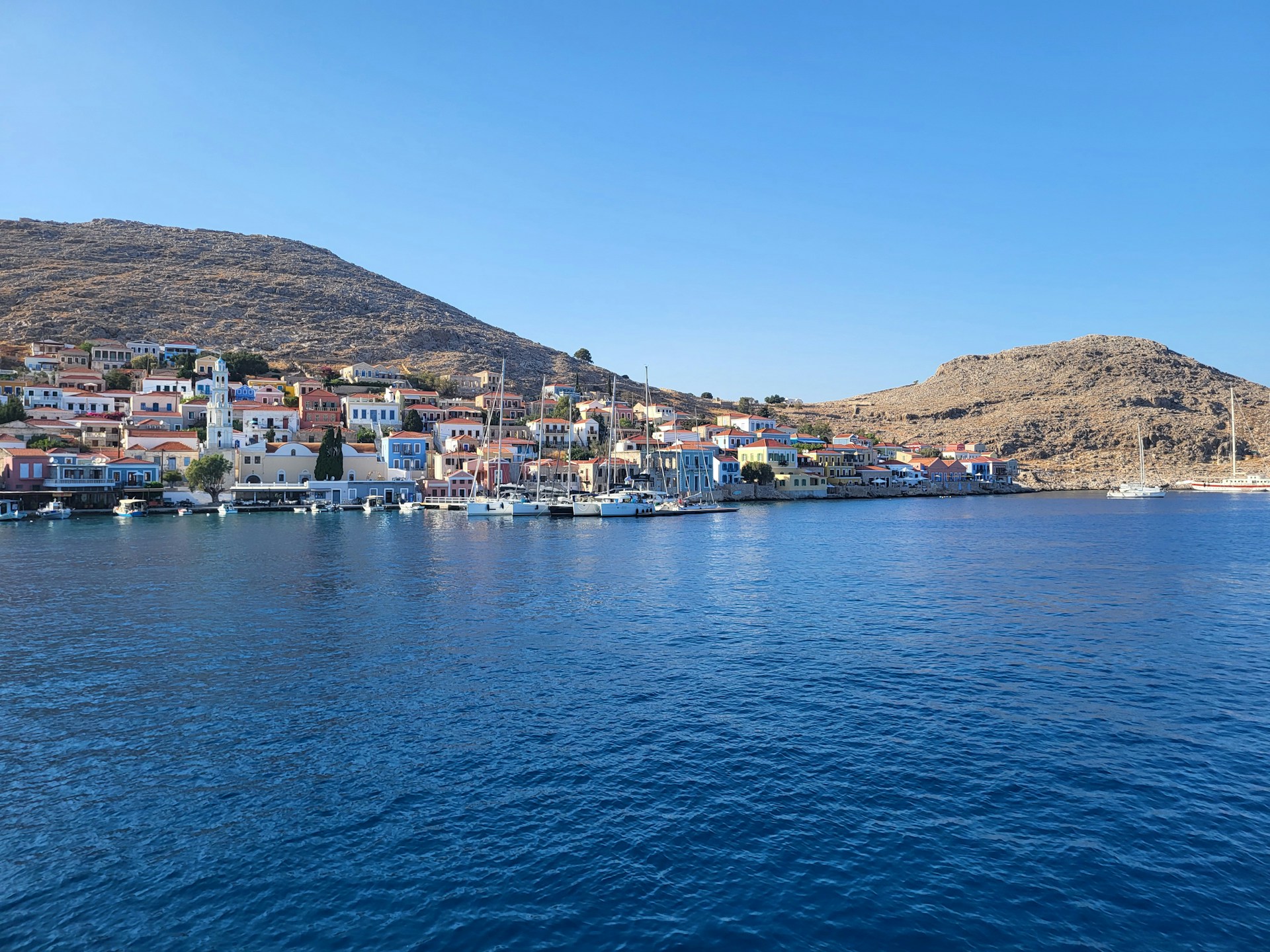
A small island less than an hour by boat from the western tip of Rhodes and a different world entirely. Halki has one village. Nimborio rises in an amphitheatre around the harbour in two-storey neoclassical mansions painted ochre, terracotta and faded blue, their floors paved with hohlakia, the black-and-white pebble mosaics that are a particular Dodecanese craft. There are no cars to speak of. The waterfront is a promenade where children play and old men sit and the same fishing boats unload every morning.
The wealth that built these houses came from sponges. Halki was, in the late nineteenth century, one of the richest sponge-diving communities in the Aegean. When the industry collapsed it took the population with it, and most of the descendants of those great captains still summer in the houses their grandfathers built. Inland, the medieval Chorio sits in atmospheric ruin under the Castle of the Knights of St John, with views across to Rhodes; the climb up is a good morning’s walk. The beaches are pebbled and clear (Pondamos for an easy swim, Areta only by boat for somewhere truly hidden), the food is fresh fish, the Halki shrimp, *kakavia* and handmade pasta, and the local spirit, *souma*, is poured at the end of every taverna meal whether you ordered it or not. It is one of the last Greek harbours that has not been retouched for visitors.
Getting there: Fly to Rhodes, then the ferry from Kamiros Skala on the west coast (under an hour) or the longer crossing from Rhodes Town. No airport of its own, which is part of the point.
Where to stay: Halki Sea House.
A nineteenth-century waterfront mansion on the harbour, restored by Eleni and Stergos and rented as a single two-bedroom house for up to four. The terrace leads directly to the water; the swim is from steps below it.
Thirassia
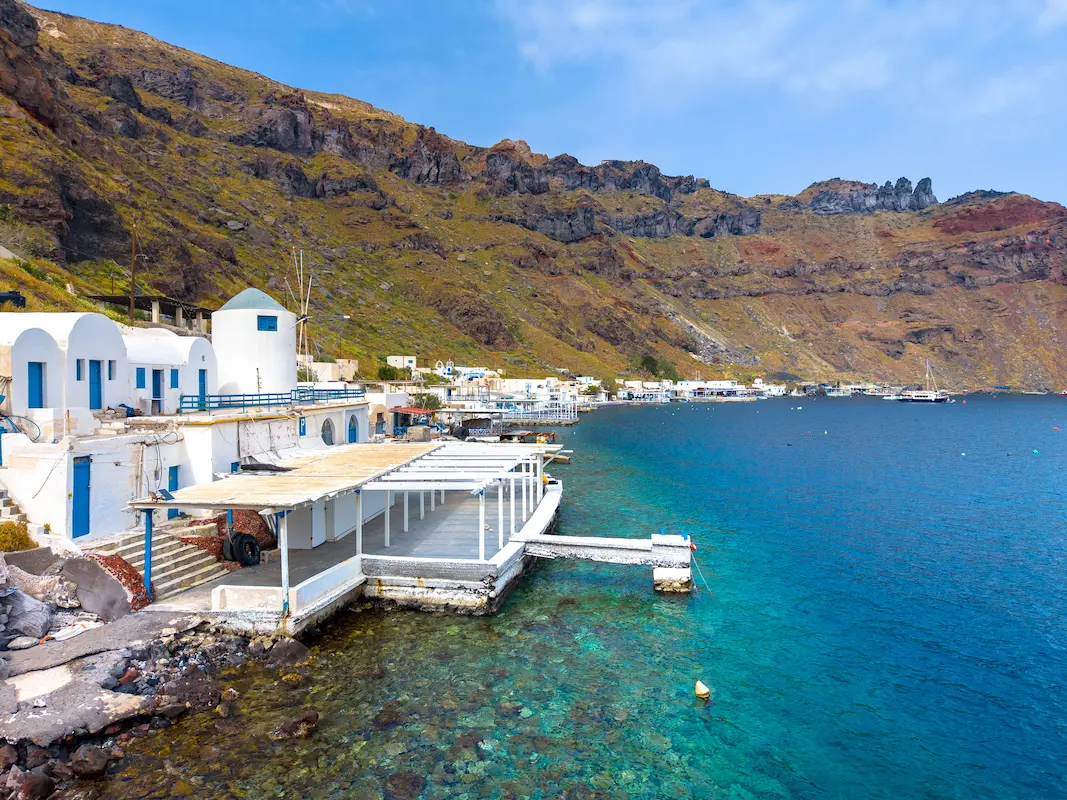
Before there was a Santorini, there was a single round island called Strongili, the Round One. Around 1600 BC it blew apart in one of the largest volcanic eruptions in human history. The eruption emptied the magma chamber beneath it, the centre of the island collapsed into the sea, and what remained were the curving rims of a flooded caldera: Santorini on one side, Thirassia on the other, and a few smaller pieces in between. Thirassia is what Santorini looked like before tourism arrived. Same caldera cliff, same volcanic geology, same vertiginous view straight across to Oia. About 300 people live here, mostly in the village of Manolas perched on the cliff edge 200 metres above the water. There is one road, a handful of tavernas, a few churches, and no cars in the village itself.
The terrain is dramatic and bare. Black, ochre and red volcanic rock layered into the cliffs, fava terraces on the high ground, fig and almond trees in the small valleys, and 270 winding steps cut into the cliff face down to the harbour at Korfos. From Manolas at sunset, you watch the day go down behind Oia across the caldera, which sounds like a consolation prize until you realise you have the view to yourself, and that the cruise-ship hordes are looking back at an empty cliff and don’t know they’re missing anything. Boat trips run regularly to Ammoudi port on Santorini in fifteen minutes, but most days you won’t want to leave.
Getting there: Fly to Santorini, then the short boat across the caldera from Ammoudi, or the local ferry from Athinios. There is no other way in.
Where to stay: Santa Irini Retreat or The Duchess.
Santa Irini is the older of the two and the one with the history, a family-run property of four suites (or a buyout for villa rental), with the caldera framed from every window and swimming pool to spend lazy days by.
The Duchess opened in 2025: twelve adults-only suites and an infinity pool perched on the cliff itself, with a fine-dining restaurant and a spa.
Kastellorizo
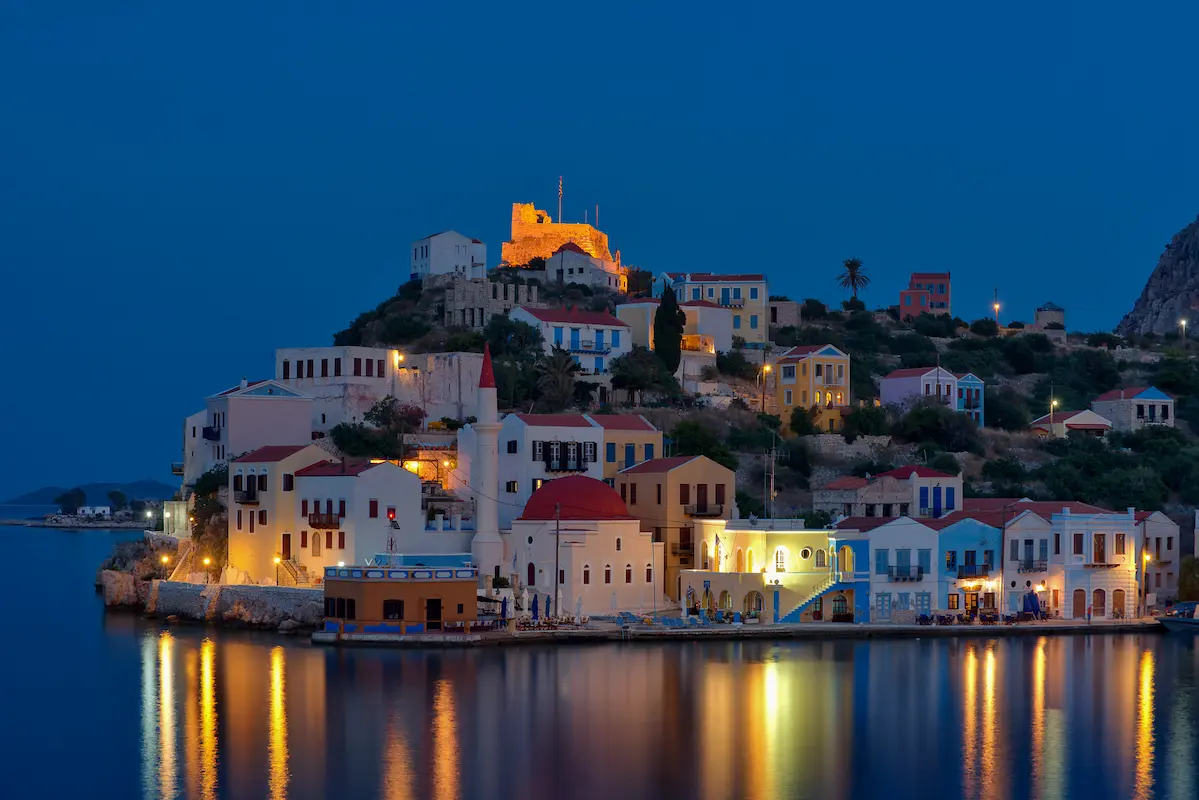
Its proper name is Megisti, the largest, given to it not because Kastellorizo is large (twelve square kilometres) but because it dominates an archipelago of even smaller islets and rocks at the eastern edge of Greece. Two kilometres of sea separate it from the Turkish coast. It is the easternmost point of the country. Almost everyone who lived here once left, mostly for Australia after the Italian occupation and the destruction of the Second World War, and almost every neoclassical mansion on the harbour was restored by their descendants returning each summer in their seventies and eighties to pass the houses on. That is the texture of the place: a town that lost its people and was rebuilt by their memory.
The harbour is the most photographed in the eastern Aegean and somehow still the least overrun. Pastel facades in ochre, terracotta and coral curve around the water in a single tight arc. Above the village, a Lycian rock-cut tomb from the 4th century BC is carved into the cliff, the only one of its kind in Greece. Above that, the Castello Rosso, the Red Castle of the Knights of St John, gives the island the second half of its medieval name. The whole island can be walked in a morning.
There are no sandy beaches. You swim from the rocks of the harbour and the smaller bays, and from a boat. The Blue Cave on the southern coast, reached only by a small fishing caique slipping under a low arch at the right hour, is one of the most luminous sea grottos in the Mediterranean; the light inside turns the water an unreal cobalt. The food is Dodecanese-Anatolian and excellent: octopus, sea urchin, strapatsada, katoumari pastries, fish straight off the boats. The point of Kastellorizo is to swim, eat, walk to the Lady of Ro’s grave on the headland and then do all of it again the next day.
Getting there: Connecting flight from Athens via Rhodes. Or fly to Rhodes and connect via hydrofoil ferry (available several times during the week, not daily). The direct Piraeus ferry runs close to twenty hours and is best left to the locals.
Where to stay: Mediterraneo and Casa Mediterraneo, both run by Marie Rivalant-Lazarakis. Mediterraneo is a small pension on the sunset side of the harbour, eight rooms in spice tones rather than Cycladic blue.
Casa Mediterraneo, the more recent project, occupies three restored mansions: six suites in total, each taking up a whole floor of its building, walls in local limestone and pigments mixed on Rhodes.
Astypalea
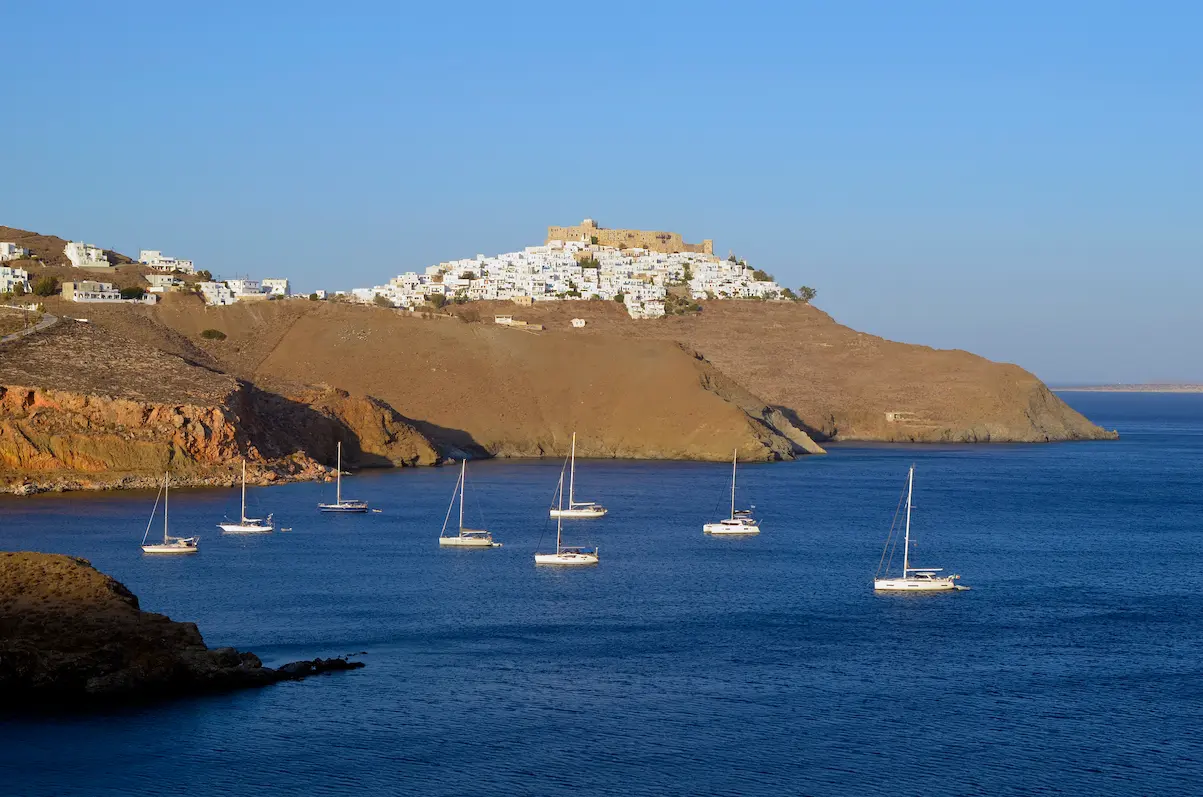
A butterfly-shaped island on the western edge of the Dodecanese, often called the Butterfly of the Aegean for the way two halves meet at a narrow isthmus in the middle. Astypalea is wild, rugged and largely undeveloped. The roads inland are mostly dirt. The beaches are reached by tracks. The Chora is one of the most photogenic in Greece, a fortified hilltown of cubic white houses topped by a Venetian castle that catches the last light long after the rest of the island has gone dark.
Astypalea is not an island of set programmes. It is an island for slow days. You rent a car (an open jeep is better), follow the wind, find a beach the team at your hotel pointed you to, eat at the kafenion in Maltezana or the seafood tavernas in Pera Gialos, and let the evenings unfold. The food is straightforward and good: saffron from the island’s own crocuses, *lambropita*, fresh lobster, goat. The island is also Volkswagen’s flagship for the switch to electric cars and solar power, an experiment in decarbonisation watched across Europe that has put Astypalea on the map for a different reason.
Getting there: A daily flight from Athens lands at the island’s small airport (an hour, and it books up months ahead), or it is the eight to twelve hour ferry from Piraeus. For island-hoppers, Astypalea links well with Kos, Kalymnos and Amorgos.
Where to stay: Two strong options, each for a different traveller.
Saluti da Stampalia has six suites on the hillside above Livadi Bay, run by Virginia and her team. The building borrows its shape from the traditional Astypalean manor houses below, every suite faces both the Aegean and the castle, and the breakfast is the part guests remember. Virginia will tell you which beach the wind favours each morning. Adults and older children only, twelve and up.
Pylaia Boutique Hotel & Spa sits a little higher in Chora, with twenty-seven rooms and suites terraced into the hill, a small spa, two pools and Cucina, its in-house restaurant looking directly across to the Venetian castle.
Pylaia is the family choice on the island, with all ages welcome, and one of the few boutique hotels with a proper restaurant on site.
Part Two of Islands You’ve Never Heard Of is coming soon: featuring greener, wilder, more textured islands of Greece: forests down to the sea, mountain villages with their own dialects, sandy beaches that run for kilometres. The islands that don’t look like the postcard, and are all the better for it.