





Paros: Our Guide
Discover Paros, Greece: Where to Stay, What to See & Things to Do
There are few islands in the Cyclades as loved right now as Paros, and fewer still that have grown so popular without losing their sense of self. Spread out enough to stay authentic even in its busiest summers, it pairs long sandy beaches and small coves with traditional villages, excellent shopping, a wave of new hotels and villas, and a table for every mood, from grilled octopus beside the fishing boats to dinners as polished as any in Athens. Its size, its range and its place at the heart of the Cyclades make it an island for families and couples, for groups of friends and for those travelling alone, each of whom will find a slightly different Paros waiting for them.
North and South
Part of what makes Paros so satisfying is the contrast between its two halves.
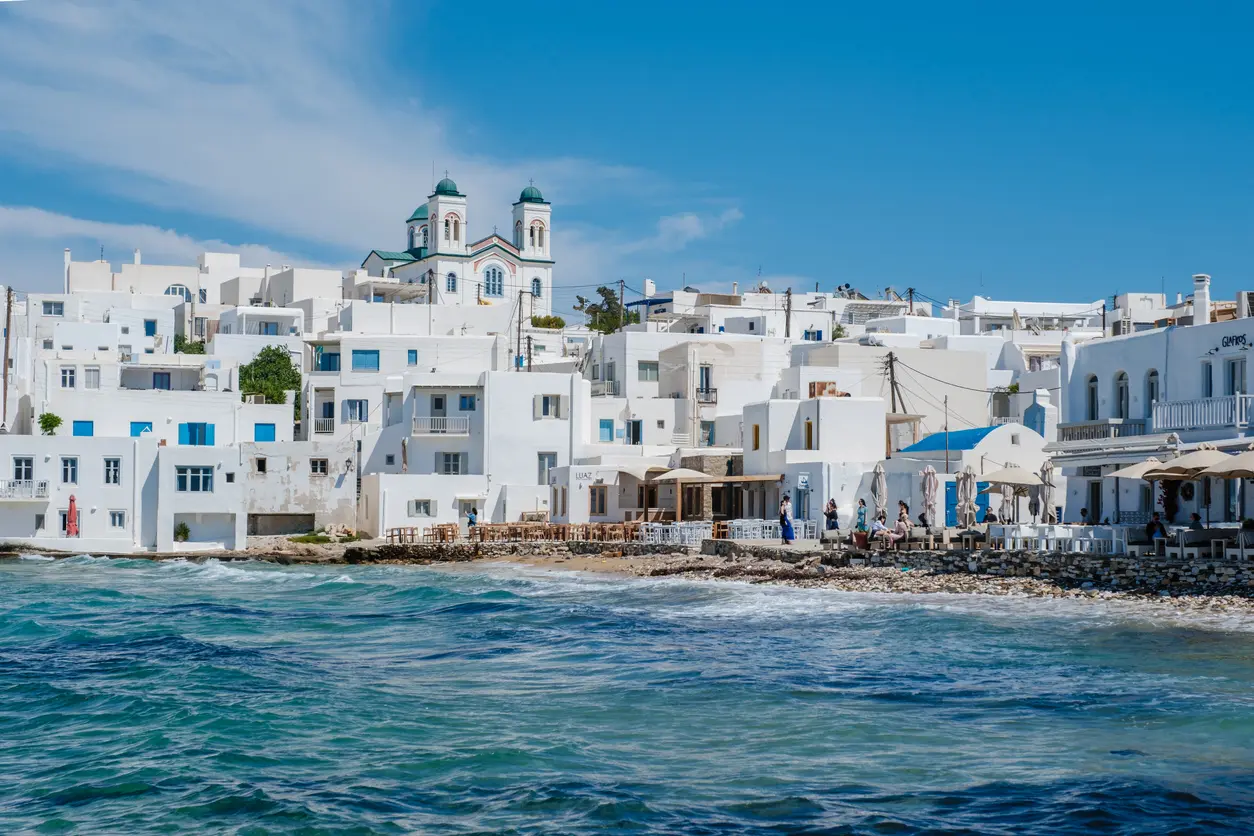
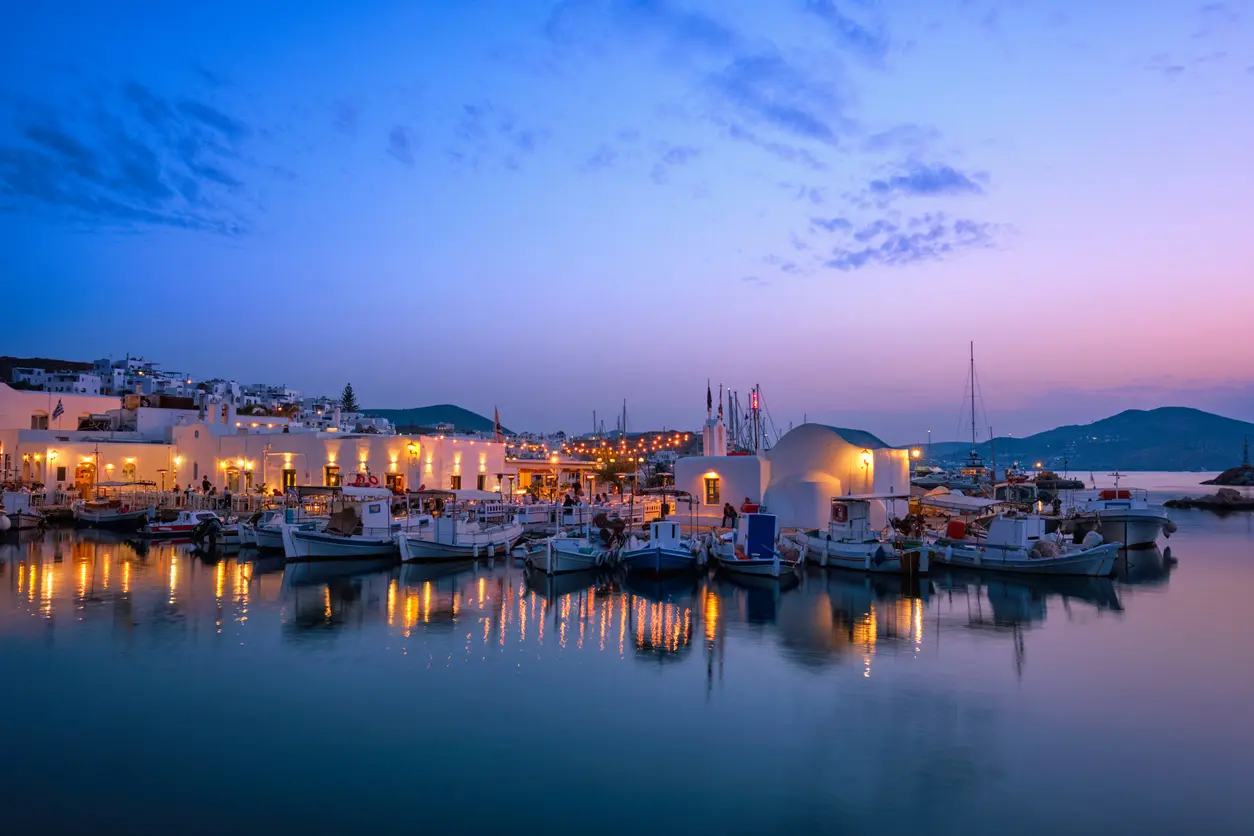
In the north lies Naoussa, the island’s most popular village, a former fishing port whose small harbour, ruined Venetian fortress and tangle of whitewashed lanes now hold most of the island’s bars, restaurants and nightlife, along with a great deal of its shopping. It is a wonderful place to be, and in July and August it is also a very busy one, which suits some travellers perfectly and sends others looking further afield.
Head south and the island loosens its collar: the pace slows, the hotels grow more secluded, the beaches open out into long stretches of sand, and from the little port at Pounda the boat to Antiparos takes barely ten minutes. The best weeks on Paros tend to make room for both.
Where to Stay
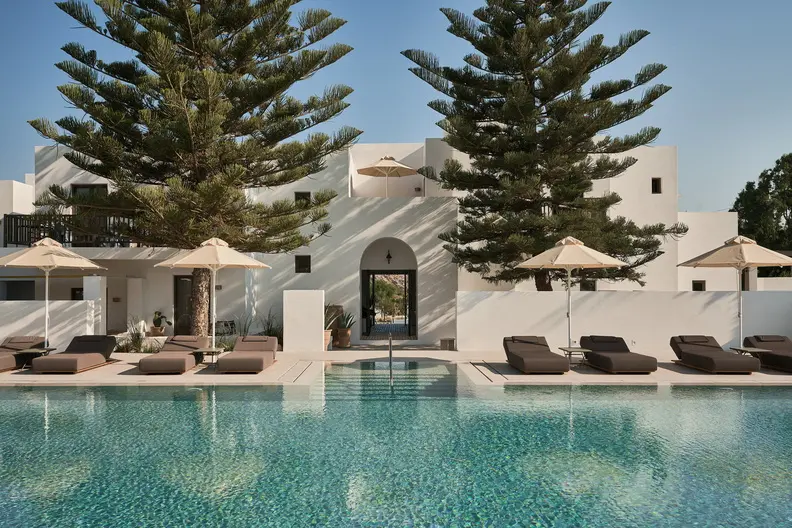
Where to stay on Paros depends, more than anything, on how much of the island’s energy you want on your doorstep. Naoussa, on the north coast, has most of the restaurants and much of the shopping, and it is where several of our favourite hotels have settled, which makes it the natural choice for a first visit or a lively week. Those who would rather be further from the bustle, or closer to the south of the island and the short crossing to Antiparos, will be happier on the west coast towards Parikia.
In and around Naoussa
Avant Mar sits directly on Piperi Beach, a short walk from Naoussa’s harbour, which makes it the hotel for anyone who wants to be in the middle of things without giving up a sunbed. A member of The Leading Hotels of the World, it arranges 38 pale, marble-detailed rooms around a saltwater pool shaped like an amphitheatre, and it is home to Matsuhisa Paros, Nobu Matsuhisa’s first restaurant on the island, as well as a little pastry shop, Figs, for the mornings. Families who need more room should look to the Avant Mar Suites, just off the beach from the hotel, where larger living spaces and sweeping views come with full use of everything the hotel offers.
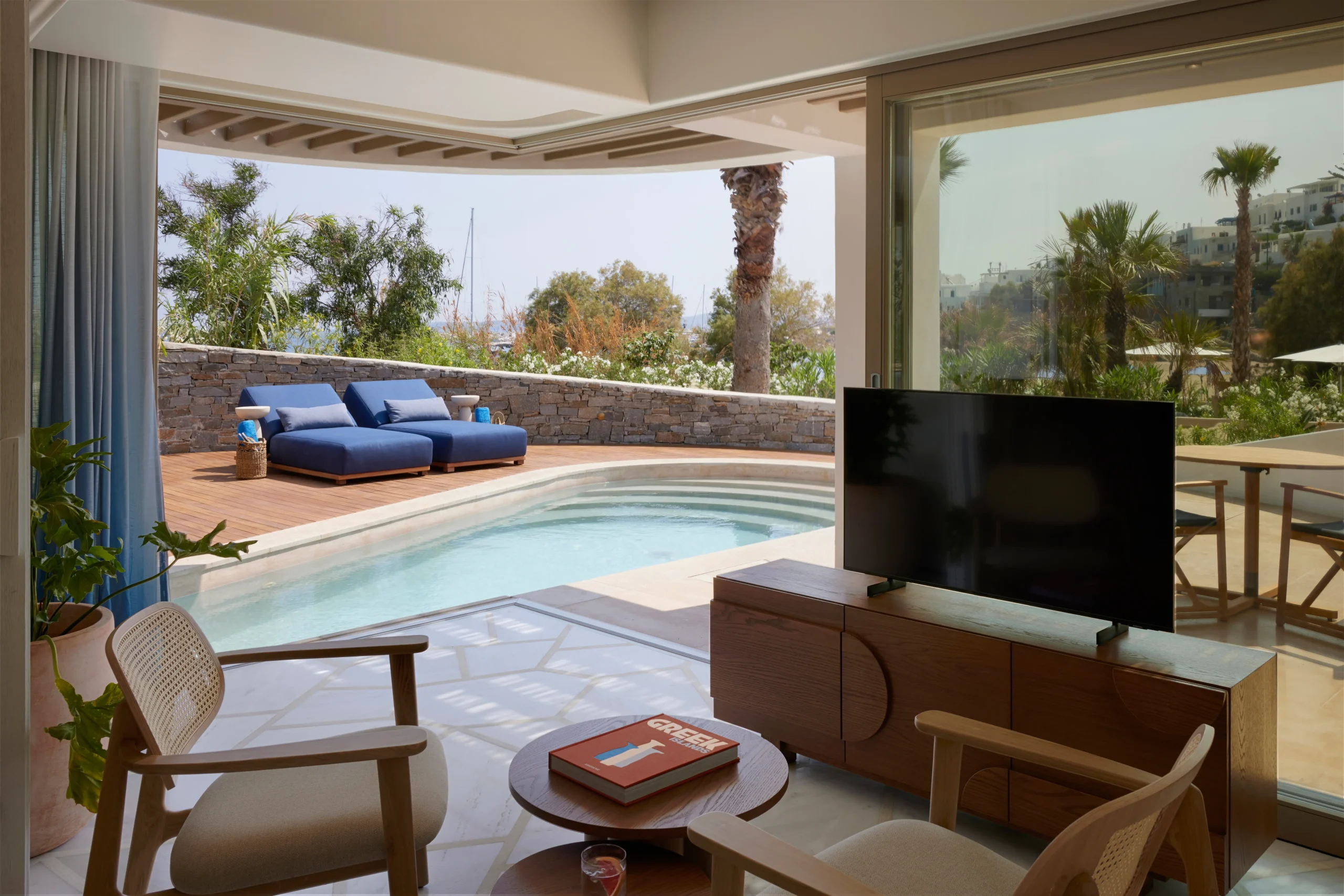
Cosme has a Cycladic character all its own, with care taken over the smallest details and works by contemporary Greek artists in the public spaces. It sits right on the beach, and a short walk through the back lanes brings you into the centre of Naoussa, so dinner in town comes without any of the summer’s parking drama. Many of its 40 suites have their own plunge pools, and there is a spa created with Korres for the slower afternoons.
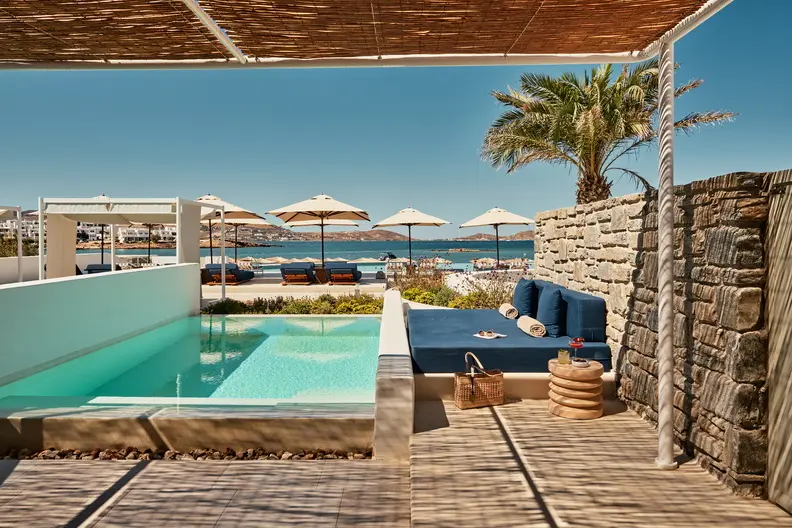
Oroséa is adults only and one of the island’s newest openings, carved into the hillside above Naoussa and built from Parian marble and weathered stone. Its suites are generously sized, each with its own pool and a view across the bay, the main pool is large and beautiful, and the service is warm and attentive throughout. The setting keeps it private, yet Naoussa is only a few minutes’ drive away whenever you want to be back in the action.
Vione lies a few minutes’ drive east of Naoussa, in Ampelas, and is the calmer proposition. All 40 of its rooms and suites face the sea, a vast butterfly-shaped pool looks across the water to Naxos, and Pino, its restaurant of Roman classics and coastal Italian cooking, makes a welcome change of pace after a week of Greek tables. Its great draw, though, is the Dione Spa, at 800 square metres the largest on the island, built around a vast heated indoor pool and complete with a ten-person Jacuzzi, a hammam, a sauna and steam room, and a suite for couples, which makes Vione as appealing on a windy day as it is in the sun. It welcomes guests aged fourteen and over, which makes it a lovely choice for couples and for families with older children.
Parilio lies a few minutes’ drive from Naoussa, between Piperi Beach and Kolymbithres, a secluded sanctuary run by a team that has every detail down to a fine art, and while it is not on the beach itself, the rooms on the first floor look out to the sea, so those are the ones to request. It has recently added a collection of magnificent villas just across the road, with two, three and five bedrooms, bringing the total to 46 suites and villas, and these are ideal for larger parties, from two couples travelling together to multi-generational families, with a minimum stay of just three nights where most villas on the island ask for five or seven. Parilio shares its owners, the Empiria Group, with Cosme, so guests can take a complimentary shuttle to Cosme’s beach club, subject to availability, and both hotels have the use of the group’s own lounge at the port, a comfortable place to rest and leave your luggage before a ferry.
Towards Parikia and the west
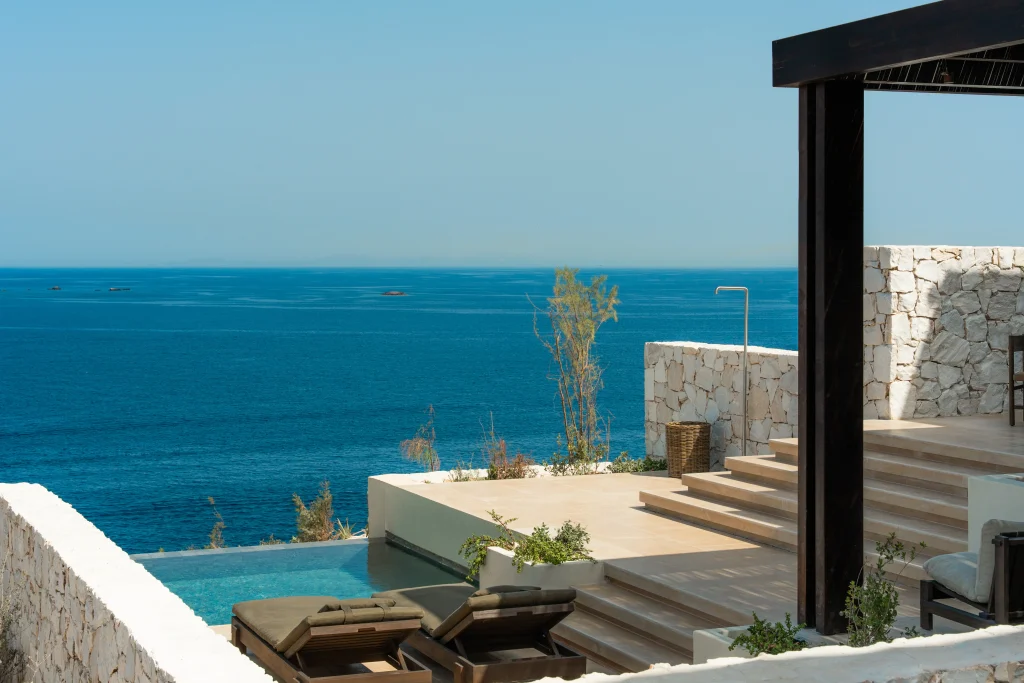
Luura opened this summer on a clifftop at Agia Irini, south of Parikia, and it is the very definition of elegance, an adults-only hotel of 39 suites, welcoming guests from the age of sixteen, where every detail has been considered and the staff are as warm as the setting is dramatic. The views over the bay are staggering, the outdoor terraces are large enough to live on, and the honey-coloured limestone and warm earth tones are especially lovely at night, when the whole hotel seems to glow. Every suite has its own art on the walls, drawn from the owners’ private collection and including works by Francesco Clemente and Sofia Mitsola, and a whimsical little booklet in each room, titled “Who You’re Sleeping With”, introduces every piece and the artist behind it. As the light begins to go, the place to be is Mimi Kakushi, the hotel’s Japanese restaurant and bar set right on the clifftop, which was made for long summer evenings of sunset cocktails and sushi, with the whole bay turning gold below you.
Andronis Minois stands at Parasporos, just south of Parikia, a contemporary take on Cycladic architecture a couple of hundred metres from the sea, with sea-view suites, a lounge deck above the Aegean and a proper spa. Unlike several of the newer hotels, it welcomes families, which makes it one of our first suggestions for those travelling with children.
Villas
For families and groups of friends, a villa is often the most rewarding way to stay on Paros, and the island has them in every corner and every setting, from houses with the sea at the bottom of the garden to hilltop homes looking out across the Aegean. We can arrange private chefs, butlers and every other service that gives a villa all the ease of a five-star hotel, and if you get in touch with us for a consultation, we will send you the options best suited to your group.
Where to Swim
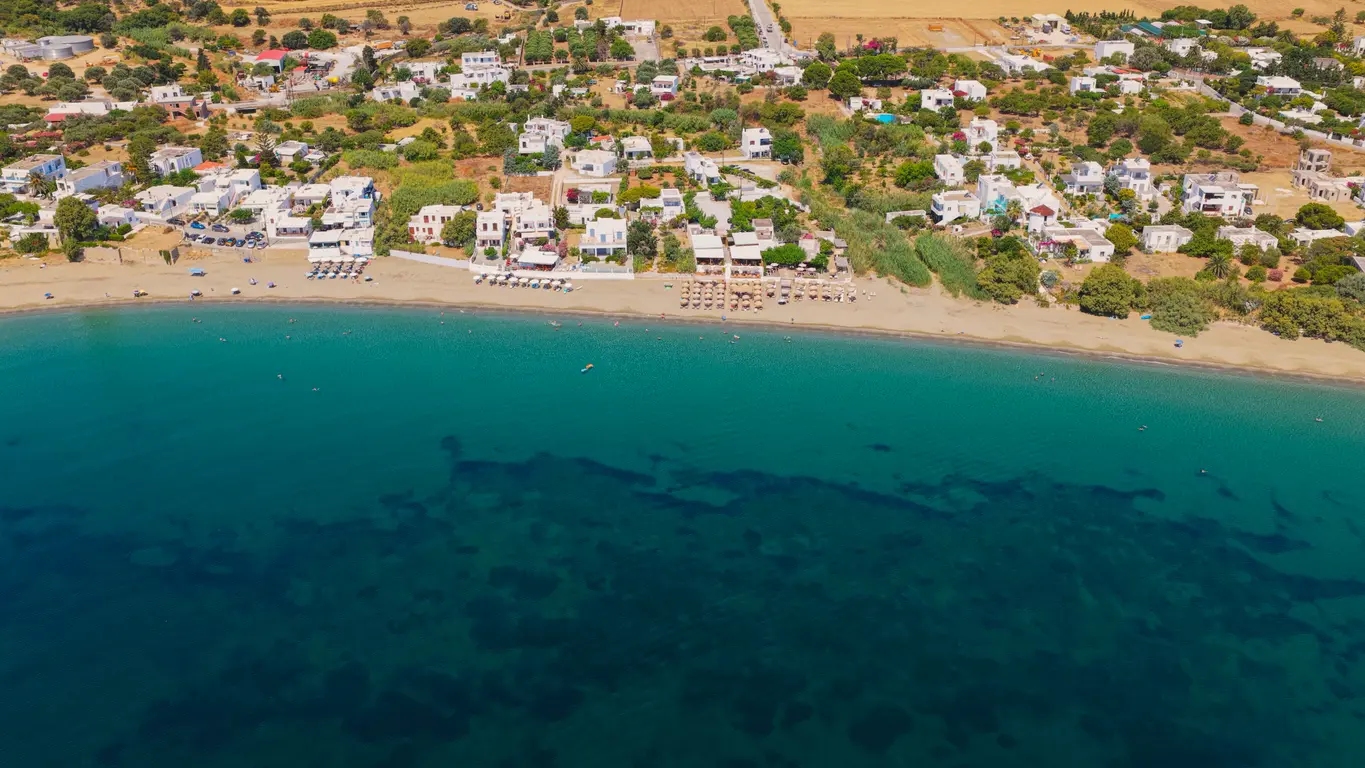
Paros has a beach for every sort of day, and the choice usually comes down to whether you would like a sunbed, a long lunch and a cold drink brought to you, or simply the sea.
Beach clubs
- Monastiri, near Naoussa: a sheltered bay with music, long lunches and a crowd that stays well past the afternoon hours.
- Krios Beach Bar, across the bay from Parikia: music and a long lunch with the town spread out across the water.
- Zazala, Parasporos: a few steps from the sand, serving everything from a late breakfast to sunset cocktails.
- Farangas Beach Bar, in the south: a full, lively day by the water at the other end of the island.
- Santa Maria, near Naoussa: sunbeds and service at a gentler pace, for those who would rather hear the sea than the music.
Natural beaches
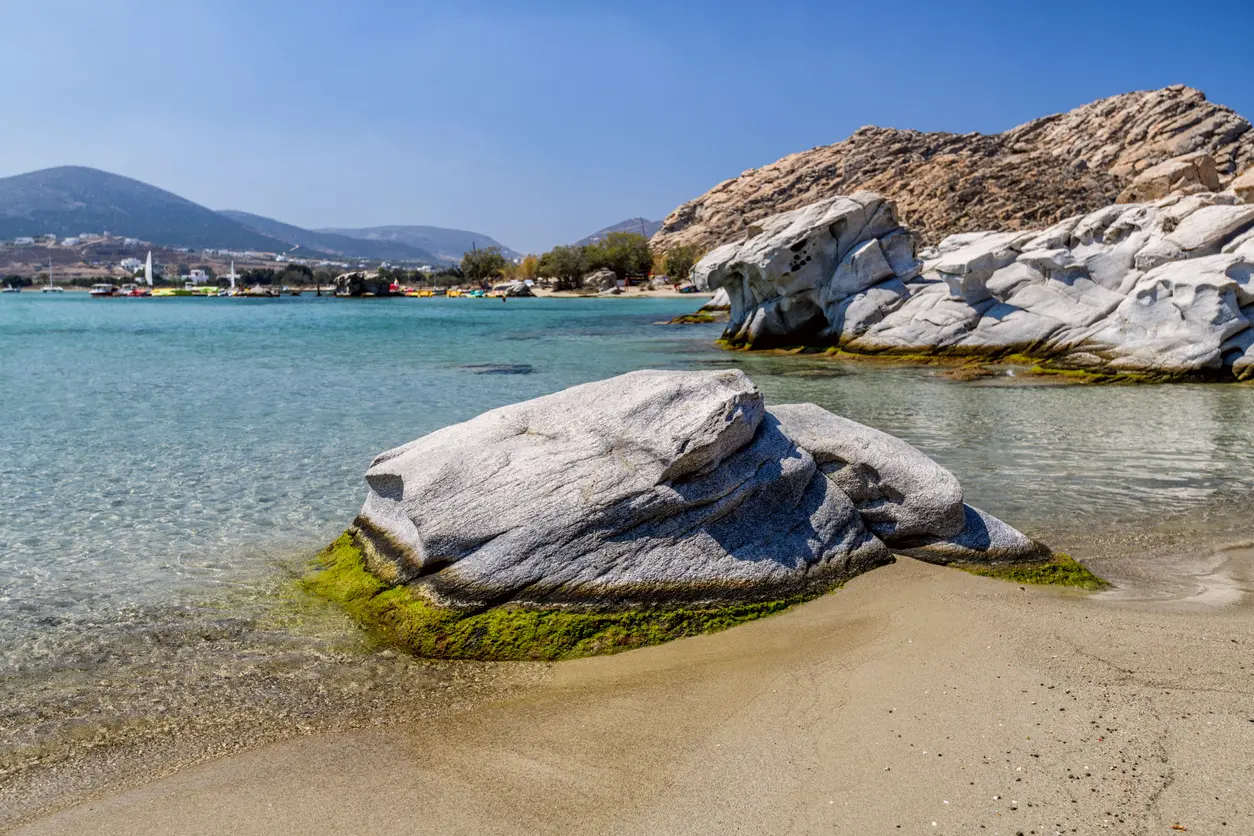
- Kolymbithres, on the bay of Naoussa: small sandy coves divided by great granite boulders that wind and sea have smoothed into extraordinary shapes, with shallow, calm water that suits children. It is the island’s most photographed beach and very busy in July and August, so arrive well before half past ten, or come later in the afternoon when the crowds thin.
- Lageri, near Naoussa: wild and without facilities, reached on foot from near Santa Maria or by water taxi from the harbour, so bring water and shade. Its southern end is popular with naturists.
- Aspros Gremos, near Ampelas: unspoilt and entirely undeveloped, yet easy enough to reach that it suits families well.
- Chrysi Akti (Golden Beach), on the east coast: 700 metres of fine golden sand, with flat water inside the sheltered bay and the windsurfers out beyond it.
- Lolantonis, on the east coast: a small sandy cove protected from the wind, with a simple beach bar at one end and tamarisk shade at the other.
- Piso Livadi, on the east coast: a shallow, sandy beach beside a harbour lined with seafront tavernas, so lunch is only a few steps away.
- Voutakos, in the southwest: sand and coloured pebbles shaded by great tamarisks, with good snorkelling and shelter when the north wind blows.
Where to Eat
Paros eats remarkably well, and its best tables are spread right across the island, from the polished restaurants of Naoussa and Parikia to the harbourside tavernas of its fishing villages, so it pays to plan a few lunches around a drive. In July and August, nearly all of them are worth booking ahead.
Restaurants
Siparos is a quick drive from Naoussa, right on the water at Xifara on the road to Santa Maria, and for many who know the island well it is the favourite table on Paros. Book for sunset, begin with the tuna tartare and leave room for the cuttlefish ink risotto.
Mario has moved from Naoussa to Parikia, where its tables now look out across the bay, and it remains one of the most accomplished kitchens on the island, built on Parian and Aegean tradition and on produce from local growers, with light, carefully judged fish dishes at its heart. Reservations are essential in high season.
Stilvi is tucked into a courtyard in the inner lanes of Naoussa, one of the most polished tables in town since it opened in 2023, with contemporary Mediterranean cooking and a cocktail list that keeps people at the table long after dinner. Begin with the dry-aged beef carpaccio and the tuna tataki, and book well ahead in July and August, when a table is hard to come by.
Thalassamou is our choice in the south, on the beach at Aliki with your feet almost in the sand, less formal than the others yet cooking the Greek classics with real finesse. Start with the revithada, chickpeas cooked slowly in a clay pot in the wood oven, and then let them steer you towards the fish of the day.
For sushi
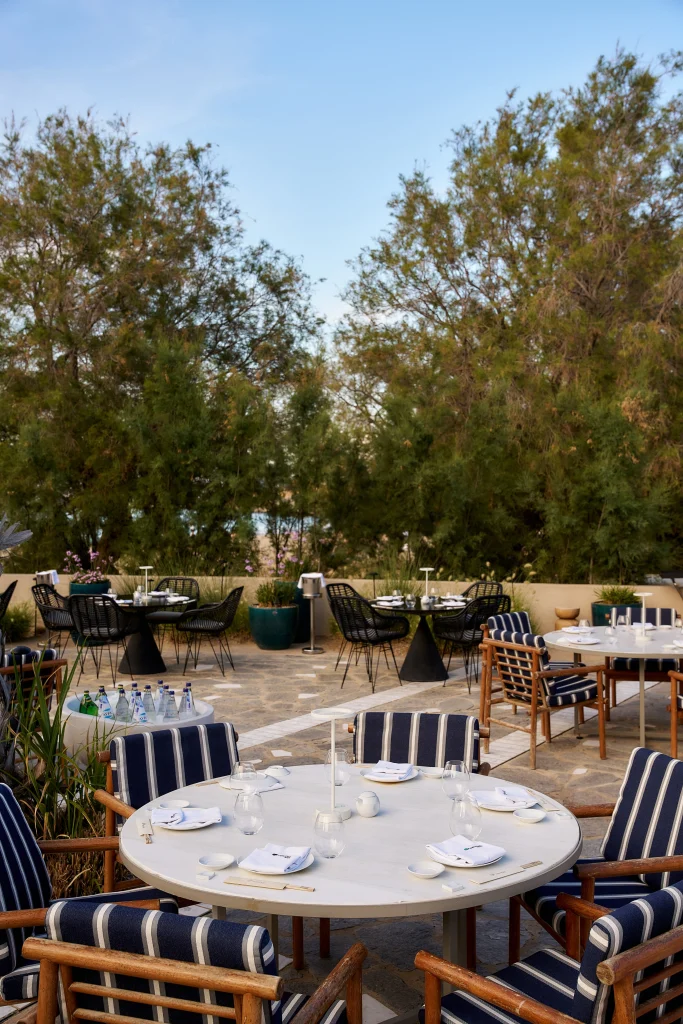
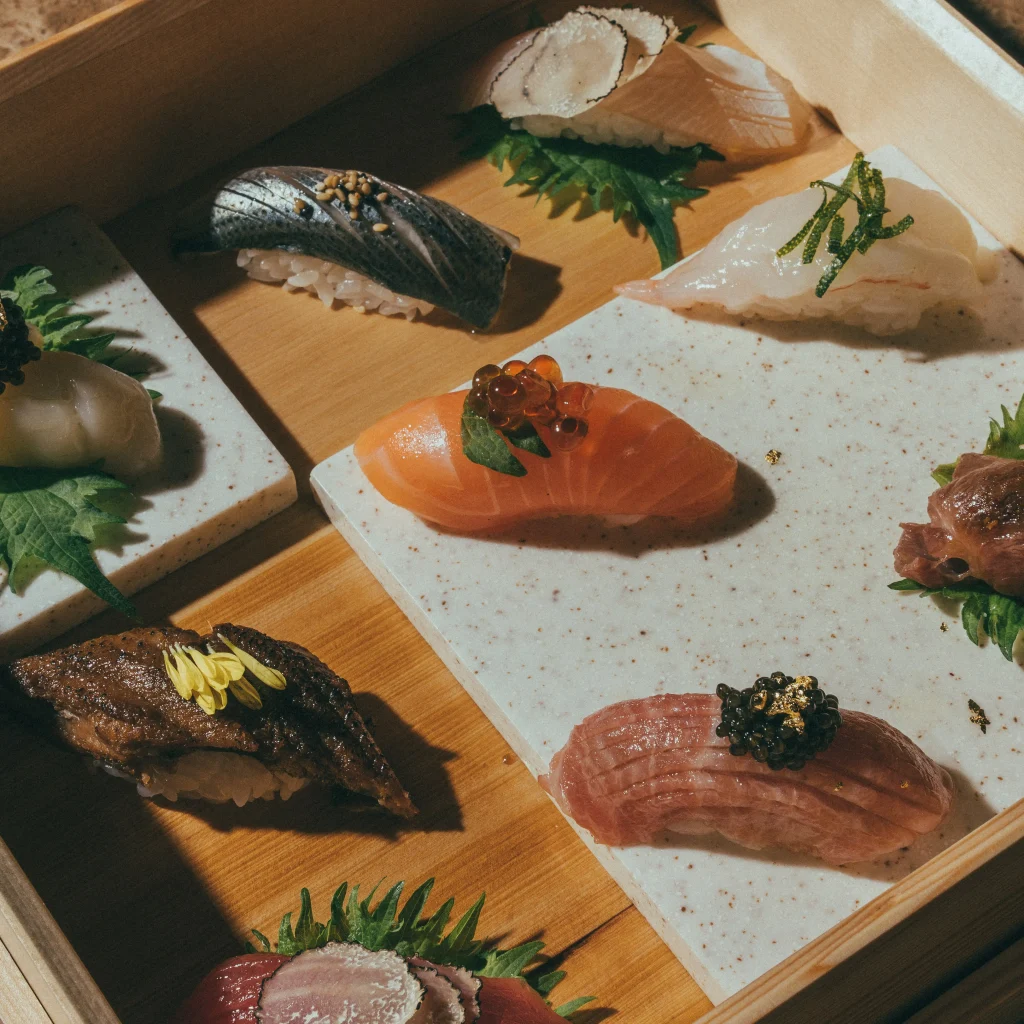
Matsuhisa Paros, at Avant Mar on the edge of Naoussa, brings the cooking of Nobu Matsuhisa to the island, set in a garden above the bay with an open kitchen, a sushi bar and a DJ who sets the mood as the evening goes on. The celebrated signatures are all here, from the black cod to the Wagyu, though the kitchen is at its most impressive when you ask for whatever has been caught locally that day and let them turn it into sashimi, and in high season it is a table worth booking well in advance.
Mimi Kakushi, the international Japanese name that has made its Paros home on the clifftop at Luura, is where the island comes to see and be seen on a summer evening, with sunset cocktails giving way to sushi and contemporary Japanese plates as the terrace fills and the bay at Agia Irini turns gold below.
Tavernas
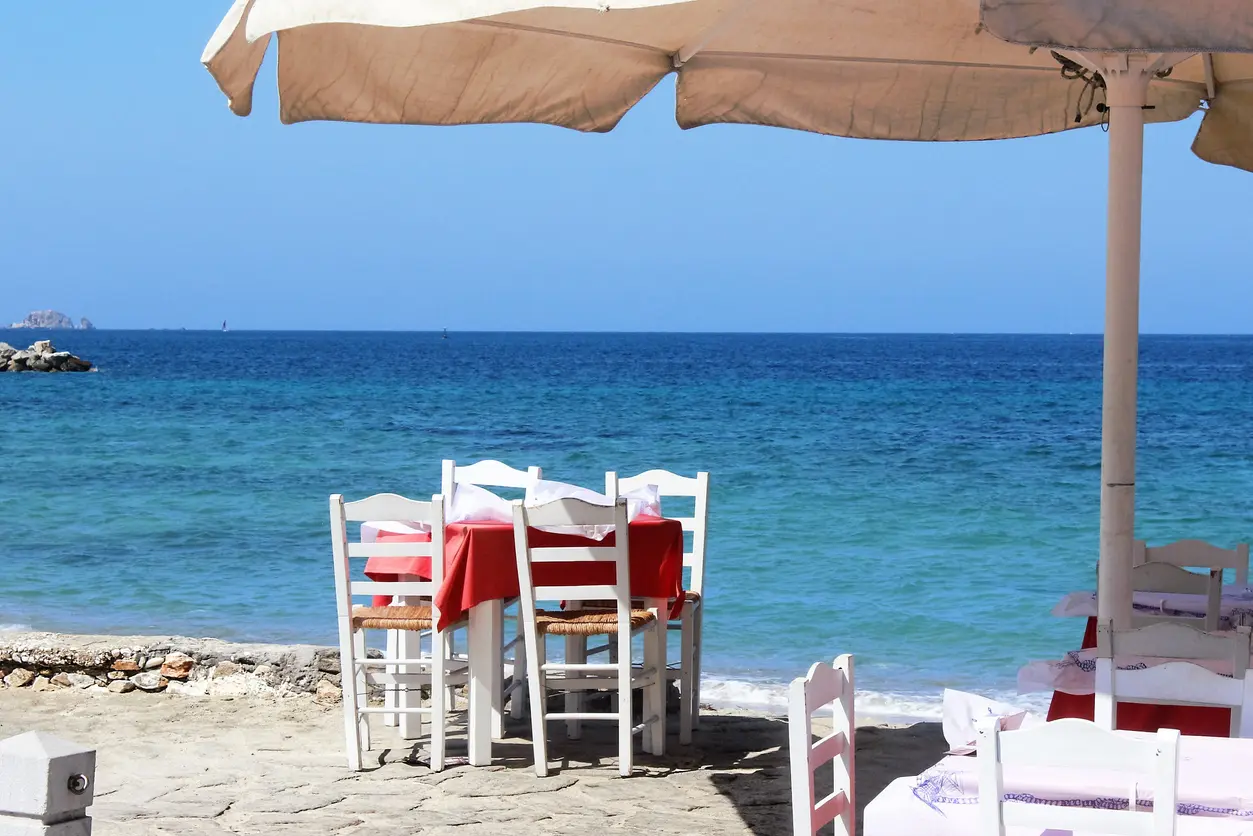
Sigi Ikthios is a wonderful waterfront taverna at the heart of Naoussa’s busy port, in the stretch of harbour where most of the town’s tavernas and bars are clustered, and on a summer evening it is very much the place to be, with fishing boats moored beside the tables and the whole harbour alive around it. Order the crayfish orzo and the shrimp in ouzo, and ask what came in on the boats that morning.
Barbarossa, a few steps along the same harbour, is the island’s social media favourite, an ouzeri since the 1960s with a line of octopus drying above the tables. Order the grilled octopus and the sun-dried mackerel, a Parian speciality, and come with fair warning that in July and August the party takes centre stage here, so it is a night remembered more for the atmosphere than for the cooking.
To Mouragio sits in the fishing village of Aliki, a family taverna run by two brothers for more than thirty years, with its tables set beside one of the smallest harbours you are ever likely to see. Start with the sea urchin and the marinated anchovies, follow with the octopus in wine, and if there is mackerel hanging out to dry, order that too.
Markakis is the place for seafood in Piso Livadi, a family restaurant on the harbour since 2000, where whatever was caught that day is the thing to order, and the lamb shank is there for anyone ready for a break from fish.
Up in Lefkes, the island’s most visited village, Klarinos has held its place on the square since 1982, a family taverna with a large terrace among huge pots of basil and gardenias, where much of the meat comes from the family’s own animals and the dakos is made with their own sourdough, and the revithada and the rooster are both worth ordering. Just outside the village, Aranto looks down the valley to the coast and across the channel to Naxos, bringing a newer approach to the taverna with a menu built on local ingredients and recipes from Paros, Crete and the other Cyclades. Its meat dishes are the draw, the sausage especially, and in summer it is worth booking a few days ahead.
Coffee & brunch
- Almond, Naoussa
- Afros, Naoussa
- Cannelait, Naoussa
- Yaya Cafe, Parikia
- Cafe Symposium, Parikia
- Ramnos Café, Lefkes
Where to Shop
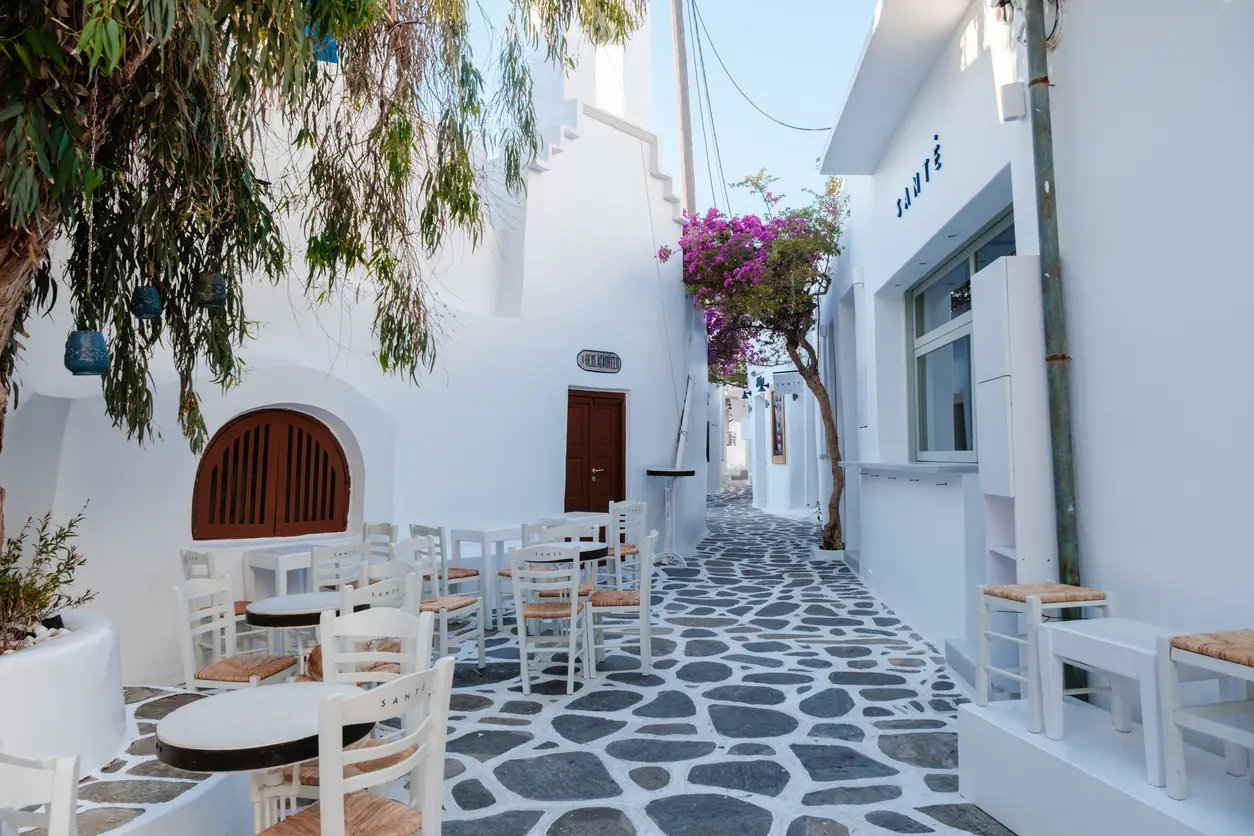
Naoussa is the place to shop on Paros, and for anyone who loves local boutiques and island crafts, the best discoveries are usually made simply by wandering its alleyways and following whatever catches the eye. A few addresses are worth seeking out along the way.
All We See Is the Sea, just outside the centre of Naoussa, is one of the best places on the island to buy local and support it. It belongs to the artist Christianna Economou, a sculptor known for bringing old wooden caiques back to life, and takes its name from the motto she paints on every boat she restores, while the shop itself is filled with her whimsical handmade creations, from trinkets and costume jewellery to playful clothing.
Luisa World, in the heart of Naoussa, is the island outpost of the Greek fashion house founded in 1975, bringing together established designer names and emerging talent, and it is the place to find something special to wear to dinner that same evening.
Anthologist has boutiques in the lobbies of both Parilio and Cosme, where vintage textiles, one-of-a-kind ceramics, jewellery and resortwear are gathered into something closer to a cabinet of curiosities than a hotel shop.
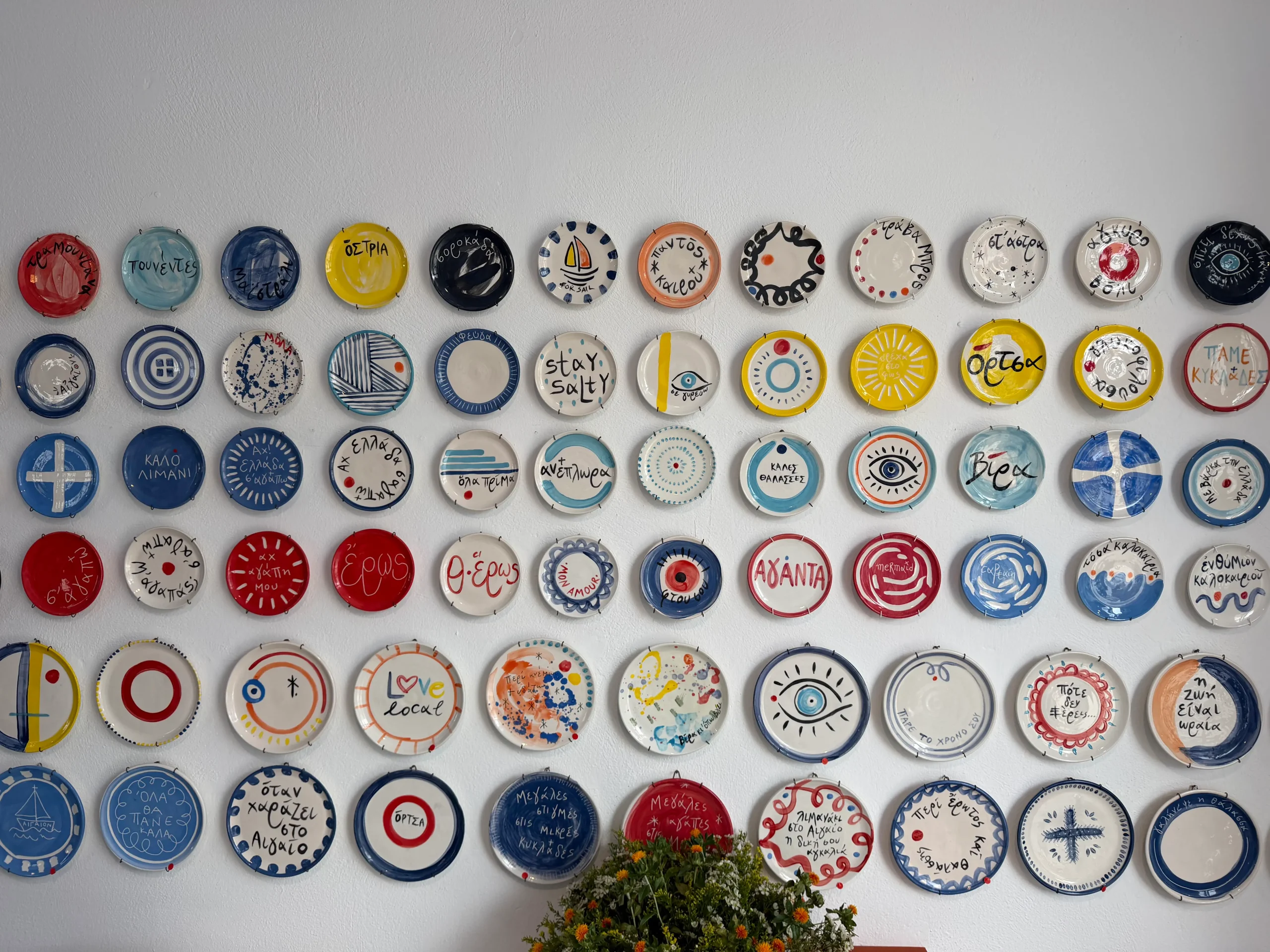
Yria has been making handcrafted ceramics on Paros since 1977, from small plates for everyday use to large decorative platters and vases, and its shop on Market Street in Parikia, behind a facade of carved Parian marble, is a pleasure to browse, with a second outpost on the main square in Lefkes.
By Land and by Sea
Paros is best understood in two parts, the island itself and the water that surrounds it, and the most rewarding weeks here make generous room for both.
By land. Beyond its villages and little harbours, the island offers far more to do than most visitors realise, and we can arrange all of it. There are cooking classes built around Parian recipes, ceramics workshops, wineries where tastings are poured among the vines and, fittingly for the island that supplied the ancient world with its finest stone, classes in Parian marble carving. Riders can head out on horseback at sunrise or at sunset, when the light is at its kindest, and walkers can follow the old Byzantine road that once linked Parikia with the hill villages and the southeast coast. Its loveliest stretch runs from Lefkes down to Prodromos, three and a half kilometres paved in Parian marble and more than a thousand years old, mostly downhill and around 45 minutes on foot, and those with more energy can carry on through Marpissa to the harbour at Piso Livadi.
By sea. The Cyclades are best seen from the water, and Paros, set almost at their centre, is the ideal place to set out from, whether by RIB or by private yacht. One of our clients’ favourite days is a full day aboard a private yacht to the Small Cyclades, swimming off Schinoussa and Iraklia, while another heads north to Rineia, the uninhabited island beside Delos. Closer to home, we can arrange a private boat for a half or full day, whether a traditional wooden caique, a motor yacht or a RIB, to carry you over to Antiparos for lunch, across to Sifnos when the sea allows, or out to Despotiko with lunch served on board. Despotiko is uninhabited, and it is the waters around it that bring people here, clear, jewel-coloured and still pristine, with the remains of an ancient temple to Apollo visible on the shore. It is well worth a full day on the water, and it is the one excursion we insist on.
The wind that shapes Paros also makes it one of the great water sports islands of the Aegean. Paros Kite Beach, just beside the port at Pounda, is the place for kitesurfing, and many of the beach clubs offer the classics, from waterskiing to inner tubing, all of which we are happy to arrange.
All of this makes Paros an exceptional base for a week. For groups of friends and multi-generational families in particular, we often recommend a villa on the island, which we can find and arrange, with the neighbouring islands taken as day trips so that no one has to repack a suitcase all week.
Villages to Wander
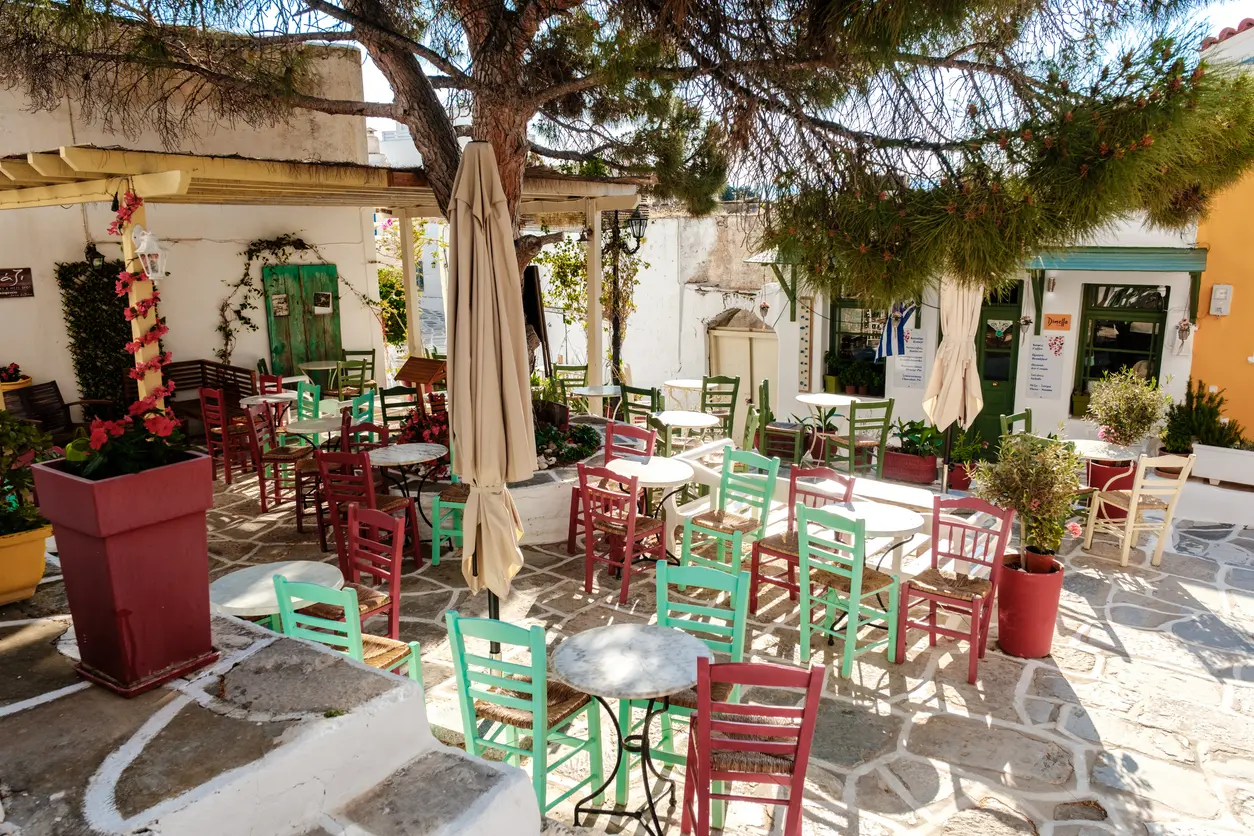
Lefkes was the island’s medieval capital and sits about 300 metres up in the hills among olive and pine. It remains, to our minds, the most beautiful village on Paros, a maze of whitewashed lanes, marble paving and bougainvillea that leads eventually to the marble church of Agia Triada and a view that stretches all the way to Naxos. Those in comfortable shoes can follow the marble-paved Byzantine path down to Prodromos, about 45 minutes on foot and one of the loveliest walks on the island, before coming back up for lunch on the square.
Marpissa is built like an amphitheatre on a low hill, with four windmills at its entrance and houses dating back to the sixteenth and seventeenth centuries. It is a more lived-in village than most, and the climb up Kefalos hill to the monastery of Agios Antonios, on the site of a thirteenth-century Venetian castle, is rewarded with one of the widest views on the east coast, while the small Nikos Perantinos sculpture museum is a reminder that marble is still very much part of the island’s life.
Piso Livadi, down on the east coast, is a working fishing harbour with a shallow bay, a small marina and a line of seafront tavernas, an easy place for a long lunch after a morning at Chrysi Akti.
Molos sits just below Marpissa, a wide, sandy bay between the hills of Kefalos and Antikefalos, shaded by tamarisks and left undeveloped, which makes it a favourite with families who want space and shallow water. A short path just before it leads to Kalogeros, a small, secluded cove framed by unusual clay rocks.
Flow of the Island
Getting there. Paros is among the easiest of the Cyclades to reach. Flights from Athens take around 40 minutes, ferries from Piraeus and Rafina take roughly three to five hours depending on the boat, and helicopter transfers can be arranged for those who would rather not think about it at all, while an upgraded airport able to receive international flights is planned for the years ahead.
Getting around. As on most Greek islands, a hire car is by far the best way to explore, giving you the freedom to move between villages and beaches at your own pace, and we are happy to arrange one for you. For evenings out, when no one wants to think about driving or parking, private transfers are plentiful on the island and can be booked in advance.
When to go. The hotel season on Paros runs from around Greek Easter, usually late April or early May, until the end of October, and for those who prefer a villa, fully staffed houses can be arranged across the same months, so the real question is less when you can go than which Paros you would like to find. In spring the Cyclades are at their most unexpected, green and flowering in a way few visitors ever see, though the sea is still cool and a swim calls for a certain resolve. By high summer the hills have turned dry and golden, the sunshine is warm and the sunsets deepen, and July and August bring the island to its busiest. September and October are, to our minds, the loveliest months of all, when the sea has spent the whole summer warming up, the light softens and the crowds thin, and because so many people live here all year, the island stays open and lively long after the smaller Cyclades have closed their shutters.
Length of stay. Five nights will give you a good feel for the island, though Paros comes into its own over a full week, particularly if you plan to use it as a base for days out on the water and across to the neighbouring islands.
Paros has all the polish of its more famous neighbours and none of the effort, and for all its new hotels and late nights, it has never once forgotten that it is a Greek island first.
Bonus: Antiparos
Across a narrow strait from Pounda lies Antiparos, the smaller and slightly wilder sibling of Paros, an island that moves to its own unhurried rhythm and has kept a character entirely its own. It has no airport, so every visit begins on Paros, and from there the little ferry from Pounda makes the crossing in barely ten minutes, while those who would rather travel privately can arrive by boat or by helicopter, both of which we are happy to arrange.
That short crossing is what makes Antiparos such an easy pleasure. In summer the ferry leaves every twenty to thirty minutes and rests for only a few hours each night, roughly between two and half past six in the morning, though the timetable shifts with the season and from one year to the next, so a long lunch, a slow afternoon at one of its beach clubs, or dinner followed by a late drink are all within easy reach. You can leave the car at Pounda and step off the boat straight into town, which is far better explored on foot in any case.
The town itself is small and full of charm, a tangle of whitewashed lanes lined with very good restaurants, excellent shopping and a handful of bars that come into their own after dark. We will be sharing much more on Antiparos soon, from how best to spend a day there to our favourite places to stay, which on this island are mostly villas. The last boat back leaves late, which is very generous of it. Whether you are on it is another matter.